Wire Format
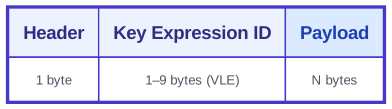
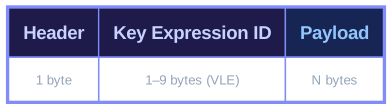
Zenoh's wire format is designed for minimal overhead — a put message requires only 5 bytes of header regardless of payload size.
Frame Structure
Variable-Length Encoding (VLE)
Zenoh uses variable-length integers throughout the wire format. Small values (< 128) use 1 byte; larger values use up to 9 bytes. This keeps overhead minimal for typical sensor payloads.
Message Types
| Code | Message | Description |
|---|---|---|
0x0B | Push | Pub/sub data delivery |
0x0C | Request | Queryable request |
0x0D | Response | Queryable reply |
0x0E | ResponseFinal | End of reply stream |
0x01 | OAM | Operations and management |
Comparing Overhead
| Protocol | Min. overhead |
|---|---|
| Zenoh | 5 bytes |
| MQTT 3.1.1 | 2 bytes fixed + variable header |
| DDS/RTPS | ~40+ bytes |
| HTTP/1.1 | ~300+ bytes |
Efficiency at Scale
At 50 Gbps throughput with sub-13 µs latency (measured on commodity hardware), Zenoh's wire format wastes nothing — a key design property for both cloud HPC and battery-powered sensors.