The Zenoh Report
January 2026
Issue #3 — ZUM25 Recap, Physical AI & Zenoh 2.0
A Note on This Newsletter
We have just stepped into a brand new year, a year which I am sure will be full of happenings. Before we move into the content of this Zenoh Report, allow me to wish you a healthy, joyful and successful 2026!
But before we continue — and in case you had not noticed: The Zenoh Report is written completely by hand. In other words, it is not generated, edited, reviewed, or corrected with AI tools. Why? Because I want it to speak with my voice, talk with my accents, and keep my editorial style. AI tools are great, but this is a conversation between me and you, and I want it to be done with my voice.
#ZUM25 In a Nutshell
As per our tradition, on December 12th we held the Zenoh User Meeting 2025 (#ZUM25). Many thanks to David Crawley, Aaron Chong, Edgar Riba, Guillaume Doisy, Fredric Olsson, Alejandro Hernandez-Cordero, and Leonard Assouline. The recording of the event is available on the ZettaScale YouTube channel.
Their presentations gave insights on how Zenoh is used today in robotics, fleet management, maritime applications, and secure group communication.
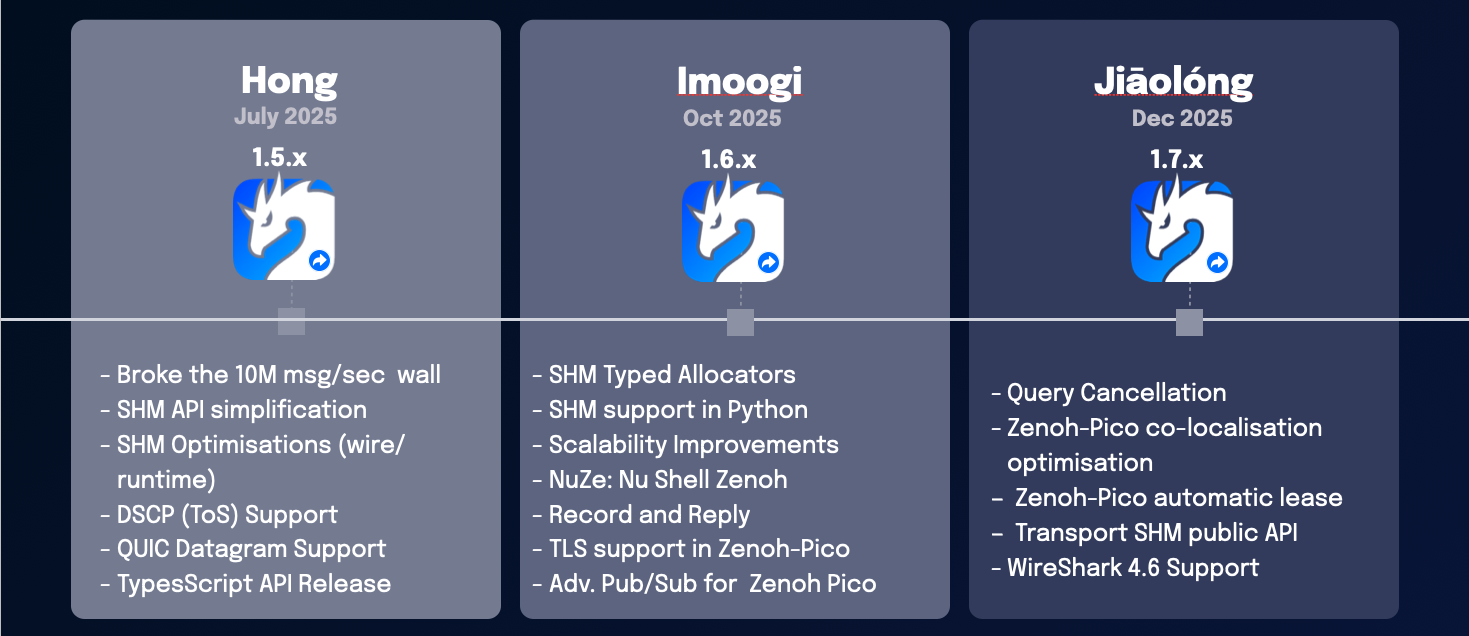
On our side we reviewed all Zenoh releases rolled out in 2025 and their key features. We introduced regionalisation — an extension of Zenoh's routing architecture and algorithms to allow for an arbitrary number of routing levels. This will massively improve scalability and we plan to start dropping features as soon as next month.
Finally, we announced that we have started to work on Zenoh 2.0 and plan to release it in the second half of 2026.
Technology Highlights: Physical AI
I had the pleasure to moderate the Physical AI Panel at ROSCon India. In preparing the panel, I had a chance to dig a little deeper into the topic and realise that concepts are not so crisply defined.
I strongly suggest reading the article "Physical Intelligence as a New Paradigm" by Meitin Sitti (Physical Intelligence Department of the Max Planck Institute). This article opens with a crisp and well written classification of the different "kinds" of intelligence where Sitti makes the difference between Computational Intelligence (CI), Physical Intelligence (PI) and Embodied Intelligence (EI):
- Computational Intelligence (CI) — cognitive processes such as reasoning, classification, etc.; historically the focus of traditional AI.
- Physical Intelligence (PI) — physically encoding sensing, actuation, control, memory, logic, computation, adaptation, learning and decision-making into the body of an agent.
- Embodied Intelligence (EI) — focuses on the tight coupling between an agent's body, the brain and the environment.
The term Embodied Intelligence was introduced in the 1980s by Rodney Brooks when he proposed that we should forget about symbol processing, internal representation, and high-level cognition, and focus on the interaction with the real world. His main point was that "intelligence requires a body."
When NVIDIA uses the term "Physical AI," their definitions closely align with what the academic community would call Embodied Intelligence. Hopefully this distinction will contribute to clearer terminology in our community.
References: "Physical Intelligence as a New Paradigm" — Meitin Sitti (Max Planck Institute) · "How the Body Shapes the Way We Think"
Release Tracker: Zenoh 1.7.x — Jiāolóng
With Jiāolóng, finally land some features that have been on the wish list for some time. Two favourites are query cancellation and Zenoh-Pico co-localisation.
Query Cancellation — the ability to cancel an outstanding query through a cancellation token. Example: a query is cancelled if a result is not received within 5 seconds. Cancellation tokens allow you to cancel a query depending on application-specific logic, which may have nothing to do with a timeout.
Zenoh-Pico Co-localisation Optimisation — ensures that any Zenoh interaction such as pub/sub or query/reply happening in the context of the same session will be short-circuited to a local call — no serialization, no system call, nothing, just a function call. This optimisation greatly reduces latency and CPU utilisation for co-located publishers and subscribers.
New Projects — zenoh-fs
zenoh-fs was designed to show one approach to solve the problem of transferring extremely large files reliably across the internet where connectivity cannot be guaranteed stable.
The challenge: traditional reliability protocols won't simply cut it. With the default configuration, Zenoh would fragment a large file into millions of fragments. If any intermediate hop crashes or gets partitioned — or if the receiver crashes after receiving 99.999% of the file — all work would be wasted.
zenoh-fs is inspired by latency-tolerant networking protocols. It leverages Zenoh's filesystem to store extremely large files as a set of fixed-size fragments. It implements a protocol to retrieve these files, leveraging checkpointing on the filesystem, to ensure that even across restarts it will resume from where it left off.
The nice thing about zenoh-fs is that you don't need to use an API to interact with it, you just need to drop a digest in the right directory. The project provides simple command line utilities for upload and download.
Zenoh 2.0 — What to Expect
We have started working on Zenoh 2.0 and plan to release it in the second half of 2026. Zenoh 2.0 will introduce significant protocol-level improvements informed by years of deployment experience. More details will follow in upcoming issues of The Zenoh Report.
Hot from the Press
One notable news: IBM's acquisition of Confluent. With its Kafka-based offer, Confluent consistently positioned itself as "The Central Nervous System for Modern Business" and IBM's move was motivated by the desire to let enterprise data flow toward the brain.
The parallel with Zenoh is unavoidable. Zenoh is emerging as The Central and Peripheral Nervous System of Robotics and alike.