Shared Memory
Zenoh provides two distinct shared-memory mechanisms. They can be used independently or together, but they serve different purposes and are enabled differently.
Transparent SHM (configuration)
When SHM transport is enabled via configuration, Zenoh automatically uses shared memory for large messages between co-located processes — no API changes required. The publisher writes normally; Zenoh detects that both endpoints are on the same host and routes the payload through a shared memory region instead of a socket.
{
  transport: {
    unicast: {
      lowlatency: false,
      shm: {
        enabled: true,
      },
    },
  },
}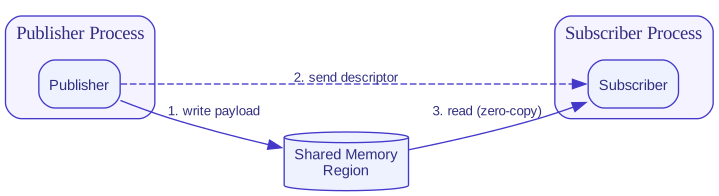
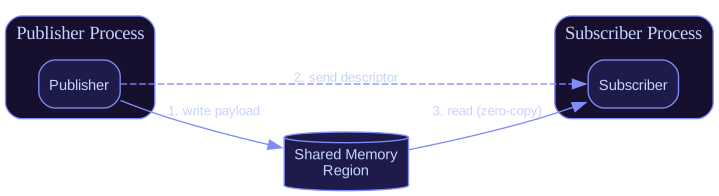
If both endpoints support SHM and are on the same machine, Zenoh uses SHM; otherwise it falls back transparently to standard transport.
SHM API (Cargo feature)
The shared-memory Cargo feature unlocks SharedMemoryManager and custom allocator
support. This gives the publisher explicit control over memory layout — useful when
you need zero-copy from the point of acquisition (e.g., a camera DMA buffer or lidar ring
buffer) all the way to the subscriber, without any intermediate copy.
Enable in Cargo.toml:
[dependencies]
zenoh = { version = "1", features = ["shared-memory"] }
use zenoh::shm::*;
let shm_manager = SharedMemoryManager::make("my_app", 64 * 1024 * 1024)?; // 64 MB
let mut buf = shm_manager.alloc(1024)?;
buf[..5].copy_from_slice(b"hello");
session.put("data/channel", buf).await?;When to Use Each
- Transparent SHM — easy win for any co-located pub/sub pair; no code changes needed
- SHM API — use when you must control allocation (zero-copy camera frames, lidar scans, video pipelines) or when you need a custom allocator strategy